EXCITING TECH FOR DIGITAL MARKETERS AND CONSUMERS

Technology developments are exciting no matter what field they occur in. In the world of digital marketing, this involves innovation that is complimentary to both marketers and the consumer. Whether its technology designed to enhance consumer experiences, or technology to aid digital marketers in their day to day operating environment, upcoming technology is exciting for all key stakeholders.

So, what are some of these exciting trends?

The Internet of Things (IoT)

Although the concept has existed for a while now, the technical elements that are being continuously improved provide a world of infinite possibilities for consumers and marketers alike. For those of you unfamiliar with the concept of IoT, I’ll leave you with the following quote.

“… [IoT involves] the concept of basically connecting any device with an on and off switch to the Internet (and/or to each other)… The IoT is a giant network of connected “things” (which also includes people).  The relationship will be between people-people, people-things, and things-things.”

Jacob Morgan, Forbes

The whole concept of IoT relies on the integration of so many other technologies to see its full benefit. Therefore, before IoT can be seen as beneficial to consumers, foundation technologies like 5G networks, blockchain and AI must prove to be highly capable.

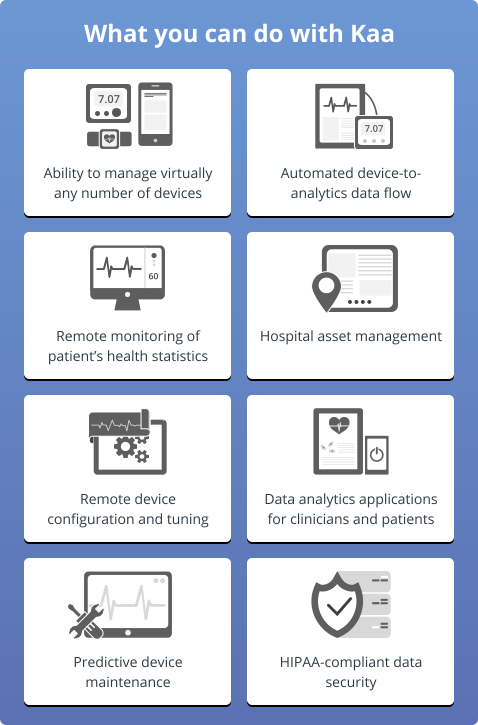
An interesting application of IoT is within the healthcare sector. The Kaa Enterprise IoT Platform is an example of how IoT can be used to improve the quality and effectiveness of service in the industry. Seen in the infographic below, the integration of smart devices, medical data bases (likely to be protected through blockchain technology) and AI enables quick and easy access, analysis and action to be taken. This is particularly critical when tensions may already be high or there are existing time pressures.
Artificial Intelligence (AI)

AI has become an expected element to the consumer experience today. We often hear about AI enhancements for the consumer experience, but what about the aid it provides digital marketers?

Using AI means that a brand can optimise their return on investment by adopting technology that ensures their ad is only placed in front of relevant viewers. Therefore, they are not wasting resources on uninterested audiences.

Furthermore, AI also helps with content creation. Washington Post’s robot reporter, Heliograf, enabled them to publish an extra 850 articles in a year. Covering topics like Rio Olympics updates, Election Day and high school football games, the robot enables journalists to do more high-value work.

One of the most helpful tools brought about by AI would be predictive analytics. Not only does it help marketers optimise their campaigns and improve operations, predictive analytics takes the guessing work out of consumer behaviour. By using predictive analytics, a brand can quite accurately assume characteristics about their target market that is beneficial when it comes to implementing campaigns. As a result, it helps make marketers more efficient and can devote their time to more important areas.

What is your favourite tech that has shaped the world of marketing? Let me know in the comments!

DATA AND THE CUSTOMER EXPERIENCE

Today’s modern business environment is saturated with more competitors than ever before. Consumers have easy access to a huge range of competitors. This creates a need for businesses to differentiate themselves from their competitors in order to stay ahead of the pack. This is where the concept of the consumer experience comes into play.

Before you can be a front runner in the customer experience you provide, there is a whole lot of back end work that needs to be done first. Big data is an incredibly valuable resource that enables a business to gain significant knowledge of their customers and market, vital to establish a meaningful customer experience. Despite the immense benefits that are associated with using big data, there are also challenges that businesses should be aware of.

A significant issue surrounds storage. IDC estimates that the amount of information stored in IT systems worldwide “…is doubling in size every two years, and by 2020 the digital universe … will reach 44 zettabytes, or 44 trillion gigabytes.” This is an insanely large amount of information for anyone to comprehend, let alone store efficiently and keep track of. It is vital for big data to be structured and organised in order to ensure it is useful and insightful for organisations.

Similarly, another issue associated with big data is being able to generate opportune insights. There is no point constantly collecting and gathering data if it isn’t being used to make decisions. When there is an unfathomable amount of information, it can be very difficult to extract insights that enable an organisation to gain a competitive advantage. Ultimately, the overarching goal of using big data is to find the pivotal chunks of data that drive your organisation’s competitive position. This requires an organisation to have a clearly defined problem early on to ensure they do not get distracted and lose sight of the issue they are trying to solve.

How does an organisation use big data to enhance the customer experience?

Previously, I have discussed the notion of customer touch-points. When discussing big data, touch-points are essentially data generating units for organisations. Each touch-point helps to create a consumer profile based on online purchase patterns, social media profiles, search terms and even banking transaction history. Firms like AXCIOM sell these personal profiles from data they have collected, providing other organisations with data to better understand and engage global audiences.

Once an organisation has the relevant big data to enhance their competitive edge, they should segment the broad customer market into smaller groups based on shared characteristics. The benefit of segmenting with big data means that organisations can delve deeper into their customer data to develop offerings that consumers really want at the right time. Similarly, this will also enable an organisation to identify and connect with niche segments that they previously would not know where or how to find.

After segmenting their consumers, organisations may wish to conduct sentiment analysis or topic modelling to gather a quick insight into opinions and attitudes of certain groups. From this information, an organisation can perform an abundance of predictive, web and data-driven optimisation analysis to ultimately formulate a successful strategy to enhance consumer experiences.

Once an organisation has collated all of this data about their consumers, it enables the business to provide consumers with a memorable experience. A success story of customer experience optimisation can be seen in Disney’s innovative Magicband. Providing consumers with an experience that is both impressive and distinctive creates sentiment among your customer base. When it is clear that a brand is making an effort to enhance the customer experience, customers feel important and as though the business has earned their allegiance. As a result, this encourages brand loyalty and life-long customers.

Do you believe that customer experience optimisation is a vital component to a brand’s digital marketing strategy? In such a competitive operating environment, do you agree that it should be a large focus for all organisations?