VIRAL MARKETING

The premise of viral marketing relies heavily on the word of mouth (WOM) promotion provided by consumers. According to Margaret Rouse, viral marketing can be defined as “any marketing technique that induces websites or users to pass on a marketing message to other sites or users, creating a potentially exponential growth in the message’s visibility and effect.” In summary, viral marketing is a method of promotion that rapidly spreads a message via consumers, usually through social media.

So what contributes to the success of viral marketing? In short, emotions. Viral marketing is believed to be amplified on the basis of emotions. BuzzSumo analysed 100 million articles to determine the characteristics of a viral-worthy article. It was believed that this was heavily dependent on the emotion evoked from the story. As depicted in the chart below created by Business Insider, 25% of the most shared articles across the web were stories that triggered a sense of awe. Marketers must be conscious of the following most effective emotions to increase the likelihood of their content going viral.

Viral examples

Contrary to popular belief, viral marketing strategies have been implemented for over 20 years. One of the first notable examples being the free email service, Hotmail. In 1997, Hotmail started inserting the tagline “Get Your Private, Free E-mail from MSN Hotmail at http://www.hotmail.com” (see example below). This was proven to be extremely successful, signing up 12 million users in 18 months, making them the fastest growing user based media company at the time. This technique has since been implemented by Apple who use the tagline “Sent from my iPhone” (see below).

One of the most iconic viral marketing examples is the Mentos and Coke experiment. A video made by Eepybird kick started the trend that went viral and sparked an abundance of videos that featured the experiment. Today, when you do a Google search for “Mentos and Coke”, you will get 7.46 million video results. The interesting part of this whole craze is the fact that neither company had a part in creating the original video, yet Coca-Cola saw a 5% sales increase and Mentos 15%. The power of viral video content is compelling.

With the rapid increase in information available on the internet, viral marketing has had to adapt. In order to capture the attention of consumers and spark e-WOM, brands need to stand out from the crowd. Depending on the brand itself, this may be through humour, surprise, outrage or shock. However, sometimes this gets taken too far and can shed a negative light on the brand.

In 2002, an Xbox ad went viral for the wrong reasons. At a time when the brand was still new, they knew they needed a way to launch themselves into the market and have an impact on consumers. This led to the creation of the ad attached below, later banned from TV after the UK’s Independent Television Commission (ITC) received 136 complaints from viewers. However, this was not the end of the ad. In a time before YouTube, the ad continued to be passed around through email and enabled the commercial to be shared over 1 million times. To this day, Xbox holds that this was beneficial for their brand.

“When you’re new, you have to be clear about what you stand for as a brand. And I think that particular idea really encapsulated everything that we were trying to represent as a new brand in the video games industry.”

Harvey Eagle, UK Advertising Manager for Xbox at the time

What are some crazy viral campaigns that you have seen? In your opinion, were they effective or just plain crazy?

EXCITING TECH FOR DIGITAL MARKETERS AND CONSUMERS

Technology developments are exciting no matter what field they occur in. In the world of digital marketing, this involves innovation that is complimentary to both marketers and the consumer. Whether its technology designed to enhance consumer experiences, or technology to aid digital marketers in their day to day operating environment, upcoming technology is exciting for all key stakeholders.

So, what are some of these exciting trends?

The Internet of Things (IoT)

Although the concept has existed for a while now, the technical elements that are being continuously improved provide a world of infinite possibilities for consumers and marketers alike. For those of you unfamiliar with the concept of IoT, I’ll leave you with the following quote.

“… [IoT involves] the concept of basically connecting any device with an on and off switch to the Internet (and/or to each other)… The IoT is a giant network of connected “things” (which also includes people).  The relationship will be between people-people, people-things, and things-things.”

Jacob Morgan, Forbes

The whole concept of IoT relies on the integration of so many other technologies to see its full benefit. Therefore, before IoT can be seen as beneficial to consumers, foundation technologies like 5G networks, blockchain and AI must prove to be highly capable.

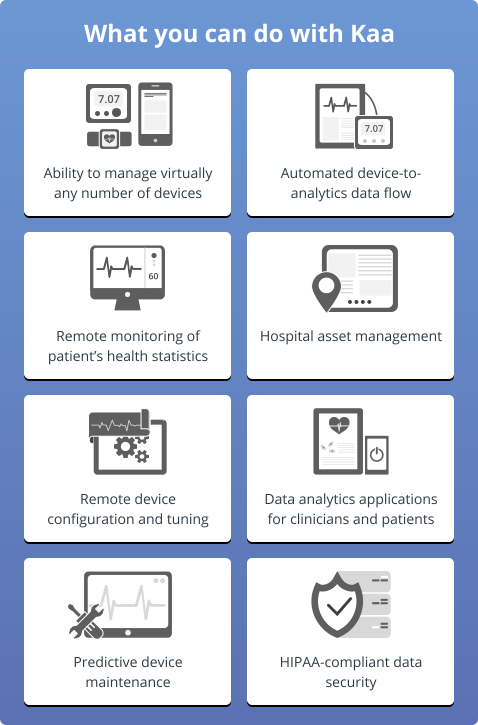
An interesting application of IoT is within the healthcare sector. The Kaa Enterprise IoT Platform is an example of how IoT can be used to improve the quality and effectiveness of service in the industry. Seen in the infographic below, the integration of smart devices, medical data bases (likely to be protected through blockchain technology) and AI enables quick and easy access, analysis and action to be taken. This is particularly critical when tensions may already be high or there are existing time pressures.

Artificial Intelligence (AI)

AI has become an expected element to the consumer experience today. We often hear about AI enhancements for the consumer experience, but what about the aid it provides digital marketers?

Using AI means that a brand can optimise their return on investment by adopting technology that ensures their ad is only placed in front of relevant viewers. Therefore, they are not wasting resources on uninterested audiences.

Furthermore, AI also helps with content creation. Washington Post’s robot reporter, Heliograf, enabled them to publish an extra 850 articles in a year. Covering topics like Rio Olympics updates, Election Day and high school football games, the robot enables journalists to do more high-value work.

One of the most helpful tools brought about by AI would be predictive analytics. Not only does it help marketers optimise their campaigns and improve operations, predictive analytics takes the guessing work out of consumer behaviour. By using predictive analytics, a brand can quite accurately assume characteristics about their target market that is beneficial when it comes to implementing campaigns. As a result, it helps make marketers more efficient and can devote their time to more important areas.

What is your favourite tech that has shaped the world of marketing? Let me know in the comments!

SOCIAL MEDIA… A BLESSING OR A CURSE?

Social media impedes on many elements of both traditional and digital marketing practices. It has developed a whole new level of complexity for digital marketers. As a result, marketers are required to constantly monitor and update their social media pages in order to stay relevant and at the front of consumer’s minds.

The upsides to social media

The main benefits of social media can be summarised by the following:

There are a huge range of benefits and opportunities that social media has provided to brands. The most advantageous ones surround monitoring and maintaining consumer relationships and opinions. Text mining and CRM technologies make it easier than ever for brands to gather, analyse and implement strategies based off the data they collect from social media. This enables them to target segments more accurately and therefore ensures the communications that are shared through social media are more efficient in communicating an intended message.

The downsides to social media

Social media is not as straight forward as it seems. There are also drawbacks that include:

One of the biggest issues that surrounds social media includes privacy. The Economist declared in 2017 that “The world’s most valuable resource is no longer oil, but data”. As social media collects increasing amounts of data, there have been a number of scandals that have surfaced relating to privacy. One of the biggest being Cambridge Analytica – I highly recommend the Netflix documentary “The Great Hack” if you are interested in learning more. As a result, consumers are becoming more sceptical of the platforms. This means social media platforms, like Facebook, are losing users – 15 million to be exact.

Implications for marketers

So, how has social media changed the way brands operate?

Brands must now use various softwares to track, monitor and analyse insights from their social media channels. These may be in the form of listening tools such as Hootsuite, user trackers like Social Blade, or even measurement tools like Google Analytics. Just naming a few, there are an abundance of softwares that brands can and need to utilise in order to ensure they are getting the most from their social media efforts.

Brands must also ensure they stay on top of complaints that are posted on social media. Online word of mouth spreads like wildfire and it is vital that brands are responding promptly to avoid crises. When complaints are posted with no response from the brand, it makes them seem careless and negligent. Therefore, brands must ensure they are regularly checking social media complaints and other review sites like Yelp as well.

Furthermore, with such a concentrated environment, brands must adopt communication strategies that are creative. When consumers are faced with 4,000 to 10,000 ads each day, consumers will only properly pay attention to those that stand out. Brands need to incorporate innovative or imaginative elements into their social media posts to ensure they are memorable and worthwhile. If they fail to do so, it will result in a waste of resources.

What do you think are potential future implications of social media for marketers? Let me know in the comments!

INFLUENCER MARKETING

Influencers – the powerful craze taking over all social media platforms. Some may describe them as “wanna-be celebrities”. However, these people are transforming the way brands can promote their products and better reach their consumers.

The concept of influencer marketing can seem confusing and unbelievable. However, the truth is that it is effective.

So, why is influencer marketing effective?

“Someone who has the power to influence the perception of others or gets them to do something different”

Gerado A. Dada, Forbes

The role of influencers are to help make a product more relatable. This is particularly important to online-only businesses where consumers are not able to physically experience the product before purchase. Therefore, influencer marketing helps businesses to eliminate scepticism and make their products familiar.

It also relies on the concept of the mere exposure effect to sell products. Even if a consumer sees a sponsored post and have no direct purchase intentions from that post, the fact that they have been exposed to the brand in a casual context makes them more likely to be a future customer. Through subliminal messages, brands are able to secure a spot in the mind of the consumer without them even realising.

Consumers are starting to become annoyed by traditional advertisements and salespeople, particularly Gen Z and the Millennials. Compared to older generations, modern consumers are interested in authenticity and trust the opinions of those who live similar lives. In fact, 70% of teens trust influencers more than the traditional celebrity.

What are the implications for marketers?

The advantage of using an influencer to promote a brand’s product surrounds the idea that they do the hard work for you in regards to capturing an audience on social media. An influencer has intentionally built their own personal brand to be trusted by their audience. Their regular interactions with their audience means the ground work is already taken care of. Therefore, by creating a link to an influencer’s brand, it enables a brand to leverage the same associations through a seemingly natural, unforced approach.

However, despite its benefits, it is not the perfect method of advertising. Now that the use of influencers have well and truly saturated social media, consumers are left with an abundance of information that is sometimes too much to consume. This may lead to a post being ignored or potentially even negatively perceived, coincidentally meaning a waste of resources for brands.

Furthermore, the overuse of influencer marketing has driven platforms like Instagram to introduce certain measures that make it clearer when influencer posts are paid ads. This has involved using “#ad” or the inclusion of “Paid partnership with XXXXXX” in influencer posts. By making it clearer to consumers through these methods, it could be argued that this minimises the benefits of influencer marketing since they are supposed to be seamless and subtle. Examples can be seen through Kendall Jenner‘s instagram page as seen below.

What are your thoughts on influencer marketing? Do you believe this will forever be an effective mode of advertisement or do you see it becoming outdated just like other traditional methods?

THE MOUNTING PRESSURES OF MOBILE DEVICES

Mobile devices mean the world is literally at your fingertips. We live in a time where people want things done yesterday. Mobile devices put a lot of pressure on businesses to keep up with the ever-changing demands of consumers. Furthermore, brands are also expected to juggle the mounting cumulation of big data that these mobile devices generate as well as provide damage control for instantaneous displays of online word of mouth (WOM), that spreads like wildfire.

Have mobile devices destroyed loyalty?

There are endless statistics that suggest it is harder than ever for brands to retain customers. Accenture found that over 50% of consumers switch service providers within a year after a single poor customer service experience. In 2017, it was found 33% of customers will consider switching companies after one poor customer service experience. Astonishingly, Salesforce predict by 2020 that 45% of consumers will switch brands if a company doesn’t actively anticipate their needs.

It is now easier than ever for consumers to assess and entertain the idea of competing products on their mobile device. As a result, levels of brand loyalty are heavily depleting as consumers are becoming more price conscious and less prudent about purchasing from unknown brands.

The harsh reality of mobile devices

“One bad review can pull your star ratings down and cost you thousands of dollars in lost business.”

Nick McVey, small business owner

Regardless of how big or small your brand may be, mobile devices create a tough environment for businesses to operate in. Failure to keep up with the demands of an impatient consumer could result in unfair negative scrutiny. A single bad review could crush a small business, particularly when 93% of consumers are reading local reviews before making a purchase decision. Nick McVey, a small business owner, has felt this effect first hand when he received an unfair review which brought down his Yelp review from 5 stars down to 4.5. He believes this one negative review alone has cost him thousands in lost business.

Today’s consumer profiles

Today, mobile devices have shaped consumers to be impatient and demanding, requiring instant gratification whilst still remaining cautious by displaying traits of uncertainty avoidance. The true effects of the negative review McVey received are emphasised when the characteristics of the modern consumer are delved into.

Firstly, the impatient and demanding consumer. Mobile devices act as supercomputers in consumer’s pockets. It enables consumers to find, learn, do and buy whenever the urge surfaces. Brands are required to deliver mobile experiences smoothly and with rapid speed to ensure that consumers are not hindered in their on-the-spot decision making process. Failure to do so may result in punishment in the form of a negative review or WOM.

Next, the consumer that demands instant gratification. An emerging expectation for consumers, consumers are looking for instant answers with ease. At a push of a button, it is expected that a company responds to them quickly if not immediately. Facebook messenger, Instagram direct messaging and chat bots mean that consumers have many options to get noticed quickly by a company in comparison to the outdated email method. This type of consumer has created the need for organisations to provide support to every customer, every time, at anytime, anywhere.

Finally, the uncertainty avoiding consumer. This consumer can be quite conservative and loves to do their research. Hardly ever will they walk into a store and buy the first item they see. They will use their mobile device to compare performance, prices and features by filtering through copious amounts of reviews.

In summary, the significant role of mobile devices in a modern consumer’s purchase journey has created many challenges for brands. This includes shaping the demands of consumers. In addition, these devices have established a need for brands to introduce “damage control” measures to try minimise the destruction that consumers can cause with a mere push of a button. These mobile devices have created a realm of convenience for consumers, as well as a complex and often destructive element to a brand’s operating environment.

Do you believe the implementation of mobile devices have created a consumer that is impossible to please? Have mobile devices created a troublesome environment for brands?