VIRAL MARKETING

The premise of viral marketing relies heavily on the word of mouth (WOM) promotion provided by consumers. According to Margaret Rouse, viral marketing can be defined as “any marketing technique that induces websites or users to pass on a marketing message to other sites or users, creating a potentially exponential growth in the message’s visibility and effect.” In summary, viral marketing is a method of promotion that rapidly spreads a message via consumers, usually through social media.

So what contributes to the success of viral marketing? In short, emotions. Viral marketing is believed to be amplified on the basis of emotions. BuzzSumo analysed 100 million articles to determine the characteristics of a viral-worthy article. It was believed that this was heavily dependent on the emotion evoked from the story. As depicted in the chart below created by Business Insider, 25% of the most shared articles across the web were stories that triggered a sense of awe. Marketers must be conscious of the following most effective emotions to increase the likelihood of their content going viral.

Viral examples

Contrary to popular belief, viral marketing strategies have been implemented for over 20 years. One of the first notable examples being the free email service, Hotmail. In 1997, Hotmail started inserting the tagline “Get Your Private, Free E-mail from MSN Hotmail at http://www.hotmail.com” (see example below). This was proven to be extremely successful, signing up 12 million users in 18 months, making them the fastest growing user based media company at the time. This technique has since been implemented by Apple who use the tagline “Sent from my iPhone” (see below).

One of the most iconic viral marketing examples is the Mentos and Coke experiment. A video made by Eepybird kick started the trend that went viral and sparked an abundance of videos that featured the experiment. Today, when you do a Google search for “Mentos and Coke”, you will get 7.46 million video results. The interesting part of this whole craze is the fact that neither company had a part in creating the original video, yet Coca-Cola saw a 5% sales increase and Mentos 15%. The power of viral video content is compelling.

With the rapid increase in information available on the internet, viral marketing has had to adapt. In order to capture the attention of consumers and spark e-WOM, brands need to stand out from the crowd. Depending on the brand itself, this may be through humour, surprise, outrage or shock. However, sometimes this gets taken too far and can shed a negative light on the brand.

In 2002, an Xbox ad went viral for the wrong reasons. At a time when the brand was still new, they knew they needed a way to launch themselves into the market and have an impact on consumers. This led to the creation of the ad attached below, later banned from TV after the UK’s Independent Television Commission (ITC) received 136 complaints from viewers. However, this was not the end of the ad. In a time before YouTube, the ad continued to be passed around through email and enabled the commercial to be shared over 1 million times. To this day, Xbox holds that this was beneficial for their brand.

“When you’re new, you have to be clear about what you stand for as a brand. And I think that particular idea really encapsulated everything that we were trying to represent as a new brand in the video games industry.”

Harvey Eagle, UK Advertising Manager for Xbox at the time

What are some crazy viral campaigns that you have seen? In your opinion, were they effective or just plain crazy?

EXCITING TECH FOR DIGITAL MARKETERS AND CONSUMERS

Technology developments are exciting no matter what field they occur in. In the world of digital marketing, this involves innovation that is complimentary to both marketers and the consumer. Whether its technology designed to enhance consumer experiences, or technology to aid digital marketers in their day to day operating environment, upcoming technology is exciting for all key stakeholders.

So, what are some of these exciting trends?

The Internet of Things (IoT)

Although the concept has existed for a while now, the technical elements that are being continuously improved provide a world of infinite possibilities for consumers and marketers alike. For those of you unfamiliar with the concept of IoT, I’ll leave you with the following quote.

“… [IoT involves] the concept of basically connecting any device with an on and off switch to the Internet (and/or to each other)… The IoT is a giant network of connected “things” (which also includes people).  The relationship will be between people-people, people-things, and things-things.”

Jacob Morgan, Forbes

The whole concept of IoT relies on the integration of so many other technologies to see its full benefit. Therefore, before IoT can be seen as beneficial to consumers, foundation technologies like 5G networks, blockchain and AI must prove to be highly capable.

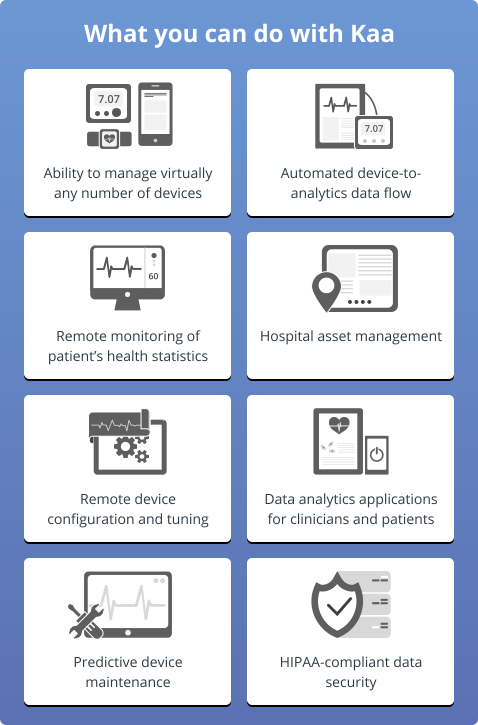
An interesting application of IoT is within the healthcare sector. The Kaa Enterprise IoT Platform is an example of how IoT can be used to improve the quality and effectiveness of service in the industry. Seen in the infographic below, the integration of smart devices, medical data bases (likely to be protected through blockchain technology) and AI enables quick and easy access, analysis and action to be taken. This is particularly critical when tensions may already be high or there are existing time pressures.

Artificial Intelligence (AI)

AI has become an expected element to the consumer experience today. We often hear about AI enhancements for the consumer experience, but what about the aid it provides digital marketers?

Using AI means that a brand can optimise their return on investment by adopting technology that ensures their ad is only placed in front of relevant viewers. Therefore, they are not wasting resources on uninterested audiences.

Furthermore, AI also helps with content creation. Washington Post’s robot reporter, Heliograf, enabled them to publish an extra 850 articles in a year. Covering topics like Rio Olympics updates, Election Day and high school football games, the robot enables journalists to do more high-value work.

One of the most helpful tools brought about by AI would be predictive analytics. Not only does it help marketers optimise their campaigns and improve operations, predictive analytics takes the guessing work out of consumer behaviour. By using predictive analytics, a brand can quite accurately assume characteristics about their target market that is beneficial when it comes to implementing campaigns. As a result, it helps make marketers more efficient and can devote their time to more important areas.

What is your favourite tech that has shaped the world of marketing? Let me know in the comments!

SOCIAL MEDIA… A BLESSING OR A CURSE?

Social media impedes on many elements of both traditional and digital marketing practices. It has developed a whole new level of complexity for digital marketers. As a result, marketers are required to constantly monitor and update their social media pages in order to stay relevant and at the front of consumer’s minds.

The upsides to social media

The main benefits of social media can be summarised by the following:

There are a huge range of benefits and opportunities that social media has provided to brands. The most advantageous ones surround monitoring and maintaining consumer relationships and opinions. Text mining and CRM technologies make it easier than ever for brands to gather, analyse and implement strategies based off the data they collect from social media. This enables them to target segments more accurately and therefore ensures the communications that are shared through social media are more efficient in communicating an intended message.

The downsides to social media

Social media is not as straight forward as it seems. There are also drawbacks that include:

One of the biggest issues that surrounds social media includes privacy. The Economist declared in 2017 that “The world’s most valuable resource is no longer oil, but data”. As social media collects increasing amounts of data, there have been a number of scandals that have surfaced relating to privacy. One of the biggest being Cambridge Analytica – I highly recommend the Netflix documentary “The Great Hack” if you are interested in learning more. As a result, consumers are becoming more sceptical of the platforms. This means social media platforms, like Facebook, are losing users – 15 million to be exact.

Implications for marketers

So, how has social media changed the way brands operate?

Brands must now use various softwares to track, monitor and analyse insights from their social media channels. These may be in the form of listening tools such as Hootsuite, user trackers like Social Blade, or even measurement tools like Google Analytics. Just naming a few, there are an abundance of softwares that brands can and need to utilise in order to ensure they are getting the most from their social media efforts.

Brands must also ensure they stay on top of complaints that are posted on social media. Online word of mouth spreads like wildfire and it is vital that brands are responding promptly to avoid crises. When complaints are posted with no response from the brand, it makes them seem careless and negligent. Therefore, brands must ensure they are regularly checking social media complaints and other review sites like Yelp as well.

Furthermore, with such a concentrated environment, brands must adopt communication strategies that are creative. When consumers are faced with 4,000 to 10,000 ads each day, consumers will only properly pay attention to those that stand out. Brands need to incorporate innovative or imaginative elements into their social media posts to ensure they are memorable and worthwhile. If they fail to do so, it will result in a waste of resources.

What do you think are potential future implications of social media for marketers? Let me know in the comments!

INFLUENCER MARKETING

Influencers – the powerful craze taking over all social media platforms. Some may describe them as “wanna-be celebrities”. However, these people are transforming the way brands can promote their products and better reach their consumers.

The concept of influencer marketing can seem confusing and unbelievable. However, the truth is that it is effective.

So, why is influencer marketing effective?

“Someone who has the power to influence the perception of others or gets them to do something different”

Gerado A. Dada, Forbes

The role of influencers are to help make a product more relatable. This is particularly important to online-only businesses where consumers are not able to physically experience the product before purchase. Therefore, influencer marketing helps businesses to eliminate scepticism and make their products familiar.

It also relies on the concept of the mere exposure effect to sell products. Even if a consumer sees a sponsored post and have no direct purchase intentions from that post, the fact that they have been exposed to the brand in a casual context makes them more likely to be a future customer. Through subliminal messages, brands are able to secure a spot in the mind of the consumer without them even realising.

Consumers are starting to become annoyed by traditional advertisements and salespeople, particularly Gen Z and the Millennials. Compared to older generations, modern consumers are interested in authenticity and trust the opinions of those who live similar lives. In fact, 70% of teens trust influencers more than the traditional celebrity.

What are the implications for marketers?

The advantage of using an influencer to promote a brand’s product surrounds the idea that they do the hard work for you in regards to capturing an audience on social media. An influencer has intentionally built their own personal brand to be trusted by their audience. Their regular interactions with their audience means the ground work is already taken care of. Therefore, by creating a link to an influencer’s brand, it enables a brand to leverage the same associations through a seemingly natural, unforced approach.

However, despite its benefits, it is not the perfect method of advertising. Now that the use of influencers have well and truly saturated social media, consumers are left with an abundance of information that is sometimes too much to consume. This may lead to a post being ignored or potentially even negatively perceived, coincidentally meaning a waste of resources for brands.

Furthermore, the overuse of influencer marketing has driven platforms like Instagram to introduce certain measures that make it clearer when influencer posts are paid ads. This has involved using “#ad” or the inclusion of “Paid partnership with XXXXXX” in influencer posts. By making it clearer to consumers through these methods, it could be argued that this minimises the benefits of influencer marketing since they are supposed to be seamless and subtle. Examples can be seen through Kendall Jenner‘s instagram page as seen below.

What are your thoughts on influencer marketing? Do you believe this will forever be an effective mode of advertisement or do you see it becoming outdated just like other traditional methods?

THE MOUNTING PRESSURES OF MOBILE DEVICES

Mobile devices mean the world is literally at your fingertips. We live in a time where people want things done yesterday. Mobile devices put a lot of pressure on businesses to keep up with the ever-changing demands of consumers. Furthermore, brands are also expected to juggle the mounting cumulation of big data that these mobile devices generate as well as provide damage control for instantaneous displays of online word of mouth (WOM), that spreads like wildfire.

Have mobile devices destroyed loyalty?

There are endless statistics that suggest it is harder than ever for brands to retain customers. Accenture found that over 50% of consumers switch service providers within a year after a single poor customer service experience. In 2017, it was found 33% of customers will consider switching companies after one poor customer service experience. Astonishingly, Salesforce predict by 2020 that 45% of consumers will switch brands if a company doesn’t actively anticipate their needs.

It is now easier than ever for consumers to assess and entertain the idea of competing products on their mobile device. As a result, levels of brand loyalty are heavily depleting as consumers are becoming more price conscious and less prudent about purchasing from unknown brands.

The harsh reality of mobile devices

“One bad review can pull your star ratings down and cost you thousands of dollars in lost business.”

Nick McVey, small business owner

Regardless of how big or small your brand may be, mobile devices create a tough environment for businesses to operate in. Failure to keep up with the demands of an impatient consumer could result in unfair negative scrutiny. A single bad review could crush a small business, particularly when 93% of consumers are reading local reviews before making a purchase decision. Nick McVey, a small business owner, has felt this effect first hand when he received an unfair review which brought down his Yelp review from 5 stars down to 4.5. He believes this one negative review alone has cost him thousands in lost business.

Today’s consumer profiles

Today, mobile devices have shaped consumers to be impatient and demanding, requiring instant gratification whilst still remaining cautious by displaying traits of uncertainty avoidance. The true effects of the negative review McVey received are emphasised when the characteristics of the modern consumer are delved into.

Firstly, the impatient and demanding consumer. Mobile devices act as supercomputers in consumer’s pockets. It enables consumers to find, learn, do and buy whenever the urge surfaces. Brands are required to deliver mobile experiences smoothly and with rapid speed to ensure that consumers are not hindered in their on-the-spot decision making process. Failure to do so may result in punishment in the form of a negative review or WOM.

Next, the consumer that demands instant gratification. An emerging expectation for consumers, consumers are looking for instant answers with ease. At a push of a button, it is expected that a company responds to them quickly if not immediately. Facebook messenger, Instagram direct messaging and chat bots mean that consumers have many options to get noticed quickly by a company in comparison to the outdated email method. This type of consumer has created the need for organisations to provide support to every customer, every time, at anytime, anywhere.

Finally, the uncertainty avoiding consumer. This consumer can be quite conservative and loves to do their research. Hardly ever will they walk into a store and buy the first item they see. They will use their mobile device to compare performance, prices and features by filtering through copious amounts of reviews.

In summary, the significant role of mobile devices in a modern consumer’s purchase journey has created many challenges for brands. This includes shaping the demands of consumers. In addition, these devices have established a need for brands to introduce “damage control” measures to try minimise the destruction that consumers can cause with a mere push of a button. These mobile devices have created a realm of convenience for consumers, as well as a complex and often destructive element to a brand’s operating environment.

Do you believe the implementation of mobile devices have created a consumer that is impossible to please? Have mobile devices created a troublesome environment for brands?

SEARCH MARKETING… IS IT IMPORTANT?

Search marketing. We’ve all heard of it. But just how vital is it for a business to have a website that is search engine optimised?

The statistics

Over time, search engines have rapidly gained popularity. In fact, the average number of daily Google searches in 2018 totalled 5.8 billion, that is 71,780 searches per second. Marketers can no longer neglect the trend that majority, in fact 93%, of consumer online experiences begin with a search engine. Furthermore, according to Junto, based on the consensus of 57% of B2B marketers, SEO generates more leads than any other marketing activity.

Contrary to popular belief, search marketing is considered critical for local businesses. Google found that four in five consumers use search engines to find products, services or experiences nearby. Of these people, those who used a mobile device to seek local information were 50% more likely to actually make their way to the store.

Search Engine Optimisation (SEO)

Businesses can no longer ignore the advantages of SEO. It has become critical for businesses of all sizes to remain competitive by ensuring their SEO is up to scratch. The proof is in the statistics. Companies that effectively implement SEO will have a significant advantage when it comes to page visitors and therefore, customers.

The importance of SEO can sometimes be neglected when it seems that paid search advertising is the easy way out. Truth is, 70-80% of consumers will ignore a paid search result and scroll down to where the organic search begins to start their journey.

It is important to note that SEO is not all about improving your rank on a certain search engine. Rather, it is about making your website better for your consumers to ultimately increase sales. When your consumers have a positive experience through their online interactions, it contributes to the positive affiliations that they associate with your brand and therefore contribute to establishing brand loyalty. On the contrary, if your website is difficult to navigate or takes too long to load, the opposite is true.

Mastering the art of SEO

In reality there is no fool proof way to reach the number one rank in an organic search. Search engine algorithms are a closely guarded secret that mean there are hundreds of tactics to aid a brand in increasing their search rankings. These can include both on-page and off-page methods to increase your ranking.

There are a range of tools available to help a business evaluate their current SEO ranking. These may include MOZ, Google Search Console or Google Keyword Planner to name a few. As organisations gradually continue to try and crack the search engine enigma and integrate various technological innovations such as AI, more and more resources will emerge to make it easier for organisations to maintain high levels of SEO.

Do you see a shift in the way consumers search for information in the future? Will technological innovation like Artificial Intelligence make or break this part of the consumer experience? Could this ultimately destroy all the hard work performed to optimise billions of websites or provide greater insight in understanding the consumer?

DATA AND THE CUSTOMER EXPERIENCE

Today’s modern business environment is saturated with more competitors than ever before. Consumers have easy access to a huge range of competitors. This creates a need for businesses to differentiate themselves from their competitors in order to stay ahead of the pack. This is where the concept of the consumer experience comes into play.

Before you can be a front runner in the customer experience you provide, there is a whole lot of back end work that needs to be done first. Big data is an incredibly valuable resource that enables a business to gain significant knowledge of their customers and market, vital to establish a meaningful customer experience. Despite the immense benefits that are associated with using big data, there are also challenges that businesses should be aware of.

A significant issue surrounds storage. IDC estimates that the amount of information stored in IT systems worldwide “…is doubling in size every two years, and by 2020 the digital universe … will reach 44 zettabytes, or 44 trillion gigabytes.” This is an insanely large amount of information for anyone to comprehend, let alone store efficiently and keep track of. It is vital for big data to be structured and organised in order to ensure it is useful and insightful for organisations.

Similarly, another issue associated with big data is being able to generate opportune insights. There is no point constantly collecting and gathering data if it isn’t being used to make decisions. When there is an unfathomable amount of information, it can be very difficult to extract insights that enable an organisation to gain a competitive advantage. Ultimately, the overarching goal of using big data is to find the pivotal chunks of data that drive your organisation’s competitive position. This requires an organisation to have a clearly defined problem early on to ensure they do not get distracted and lose sight of the issue they are trying to solve.

How does an organisation use big data to enhance the customer experience?

Previously, I have discussed the notion of customer touch-points. When discussing big data, touch-points are essentially data generating units for organisations. Each touch-point helps to create a consumer profile based on online purchase patterns, social media profiles, search terms and even banking transaction history. Firms like AXCIOM sell these personal profiles from data they have collected, providing other organisations with data to better understand and engage global audiences.

Once an organisation has the relevant big data to enhance their competitive edge, they should segment the broad customer market into smaller groups based on shared characteristics. The benefit of segmenting with big data means that organisations can delve deeper into their customer data to develop offerings that consumers really want at the right time. Similarly, this will also enable an organisation to identify and connect with niche segments that they previously would not know where or how to find.

After segmenting their consumers, organisations may wish to conduct sentiment analysis or topic modelling to gather a quick insight into opinions and attitudes of certain groups. From this information, an organisation can perform an abundance of predictive, web and data-driven optimisation analysis to ultimately formulate a successful strategy to enhance consumer experiences.

Once an organisation has collated all of this data about their consumers, it enables the business to provide consumers with a memorable experience. A success story of customer experience optimisation can be seen in Disney’s innovative Magicband. Providing consumers with an experience that is both impressive and distinctive creates sentiment among your customer base. When it is clear that a brand is making an effort to enhance the customer experience, customers feel important and as though the business has earned their allegiance. As a result, this encourages brand loyalty and life-long customers.

Do you believe that customer experience optimisation is a vital component to a brand’s digital marketing strategy? In such a competitive operating environment, do you agree that it should be a large focus for all organisations?

A MODERN-DAY CUSTOMER JOURNEY

Imagine walking into your favourite store. There is a familiar smell that radiates off the products that surround you, a friendly sales assistant who asks about your day – your experience is consistent every time you return. It is why you keep coming back! This is what you might perceive to be the typical customer journey, right?

Truth is, the customer journey begins the first time a consumer becomes aware of a brand. The customer journey begins long before you walk through the entrance of the store, and continues long after you walk out too.

In a time before the internet, a customer would typically become aware of a brand through word of mouth, exposure to print advertising or a billboard. However, the age of digital disruption has profoundly impacted this path. Today, there are unlimited variations of a customer journey. This is hugely due to the expansive amounts of digital information available and communicated to consumers, often spoon-fed through their daily social media fix. The abundance of options consumers have available to purchase products or services online makes it vital for an organisation to effectively predict and foresee a customer’s purchasing behaviour from initial brand awareness to brand advocacy.

“The average customer uses 10 channels to communicate with companies”

Scott Rheinlander, SalesForce

The importance of providing meaningful and impactful customer experiences has become an emerging priority for organisations. It is more critical than ever for businesses to make memorable points of contact with consumers in order to remain competitive. As a result, there are a range of digital technologies that allow businesses to capture customer experiences in real-time and assist marketers to evaluate which touch-points are most critical in the customer journey.

ATTRIBUTION MODELLING

Sample Customer Journey with Attribution Modelling, Bright Vessel

A debate that arises from customer journey mapping surrounds the concept of “Attribution Modelling”. In the image above, Bright Vessel visually displays a sample customer journey, mapping out the number of touch-points and then relating them to the corresponding departments.

So, how do you evaluate which touch-point holds the most value? There are many types of marketing attribution models that use different approaches to assign value to specific channels. The question is, how do you achieve consistency across products within an organisation or across organisations? Is it fair to compare apples with oranges?

Although there is a lot of fancy technology for organisations to utilise, if attribution modelling eventually comes to be a legitimate form of asset valuation, this issue will come to be a headache for marketers and accountants alike. Ultimately, it is not an accurate framework and rather, should be used as a guide for businesses. I believe that attribution modelling can definitely be beneficial for an organisation. However, it should not be solely relied upon for decision making nor asset evaluation due to its absence of a range of components.

Do you believe that monetary value should be distributed on the basis of attribution modelling? Do you agree that it should not be the only tool used for decision making?

HOW DOES DIGITAL MARKETING HELP A BRAND STRATEGICALLY?

As discussed in my previous post, the notion of digital marketing is a relatively new concept. As a result, many models that have been developed over time have become gradually less relevant and applicable. That is not to say that they have become completely useless. Rather, there is a need to adapt and innovate models to become more relevant for today’s modern operating environment.

Digital marketing has been a major disruption to a brand’s marketing management processes. The rapid impact of globalisation as a result of technology has created the need for businesses to perform market analyses in even greater depth than ever before. Ignorance to your micro, meso and macro environments could quite easily result in a brand lagging behind and losing significant market share if they fail to have a thorough understanding of the elements that surround them.

Furthermore, distribution channels are another element of marketing strategy that has been heavily disrupted by technology. It is believed that for a brand to ensure long-term existence and success, an integrated, multi-channel approach is vital. Today, consumers want the best of both worlds. They want to be able to quickly evaluate options through online comparison. In addition to having this convenience, many consumers also want to physically compare and evaluate before making a purchase as well, particularly for more expensive products or products they want immediately. In fact, approximately 80% of shoppers will go in store when a website shows that the product they want to purchase is in stock at a nearby store. The growing increase in this consumer behaviour trend may require brands to shift their current marketing distribution strategy.

An element that has remained consistent despite the disruption of technology is maintaining a clear mission and vision. Ultimately, this could be considered the most important component of a brand’s marketing strategy. Staying on track with these aspects ensures that the brand does not lose sight of their identity and what they want to accomplish. In order to establish a confident customer base, a brand needs to effectively portray their mission and vision. This could be both implicit or explicit.

After discussing the implications of digital marketing on strategic planning, the conversation naturally progresses to what businesses should be doing. So, what should be present in every strategic marketing plan?

Half a century ago, the life expectancy of a firm in the Fortune 500 was around 75 years. Now it’s less than 15 years and declining even further.

Steve Denning, Forbes

The most important component of a modern-day strategic marketing plan is to have the element of adaptability. In order to stay relevant, competitive and front-of-mind to consumers, businesses must be open to change. Business environments are shifting quicker than ever. Today, it is so easy to fall behind the pack if a business does not keep an open mind about adapting aspects of their strategy.

Do you agree that adaptability is a crucial characteristic for a business to have in today’s digitally disrupted world? Is this the key success factor to a modern organisation?

HOW CAN WE DEFINE “DIGITAL MARKETING”?

Over time, consumers and businesses have become increasingly reliant on technology. The rapid integration of technology in the daily lives of so many requires businesses to ensure they do not lag behind.

No longer are consumers getting information primarily from newspapers, books or television. In today’s modern world, consumers are endlessly confronted with information via social media, online press and digitalised ads. The way people search, shop and interact has all become digitalised, meaning offline marketing is not as effective as it used to be.

A major aspect of digital marketing is the shift in the way people search for information. No longer are they spending hours in the library… rather, they instantly grasp the information they need by asking a popular friend named Google. This demonstrates the shift of the “information economy”, therefore, calling for businesses to adapt the way they interact with consumers.

As such, the concept of “digital marketing” emerges.

So, how can “digital marketing” be defined?

“The use of information communication technologies (ICT) to understand, create, communicate and deliver value to customers and the organisation”

Peter Wagstaff

Peter Wagstaff of Monash University touches on some interesting components of digital marketing. Adopted from the American Marketing Association’s definition of marketing, this definition accurately fits a traditional model of marketing. However, it does not go into great depth in relation to the actual processes and impact that digital marketing has on the modern consumer.

Fundamentally, marketing has always involved ensuring that a brand connects with their specified target market at an opportune place, at the right time. In a modern context, businesses must encounter the consumer where they are already spending the most amount of time – on the internet.

The definition of internet marketing should discuss the modes of communication, tools of communication and impacts of these on the target market. This will accurately encapsulate the essence of everything that is digital marketing.

What are your opinions on defining “digital marketing”? Do you believe that such an emerging topic can be defined accurately when it is constantly shifting and changing?